The Strength of a Cracked Cup
"Excuse me."
You raise your hand. You point a finger. There is a tone of slight accusation in your voice.
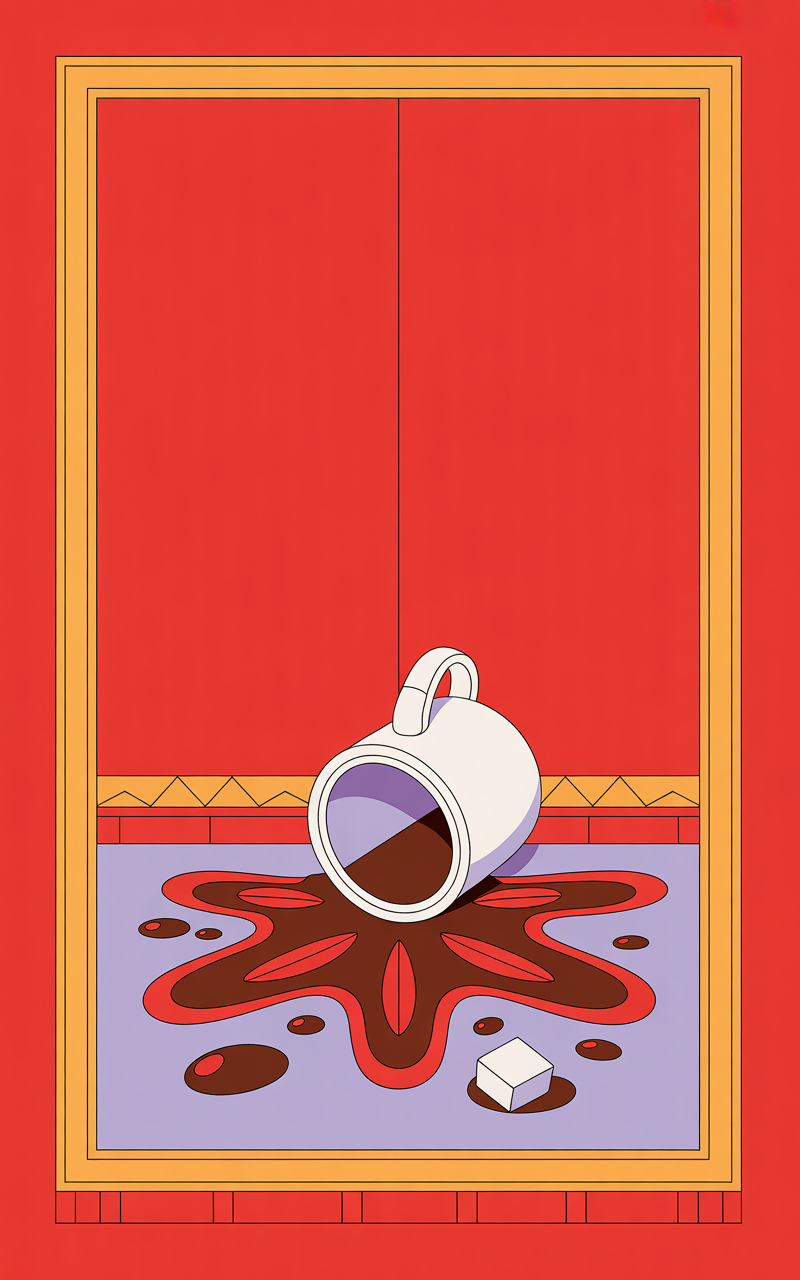
"This cup has a chip in the rim."
You expect an apology. You expect the barista to rush over, face flushed with shame, to whisk the offending object away and replace it with a pristine, factory-perfect clone. Because in the world of commerce, a flaw is a failure. A crack is a sign of negligence.
But pause. Look at the cup again.
Run your thumb over the rough edge where the ceramic gave way. Feel the texture of the clay underneath the glaze.
Why does this offend you?
It offends you because you are addicted to the lie of perfection.
We live in a culture of the "Brand New." We want our phones to be scratch-free. We want our apples to be perfectly round. We want our faces to be smooth and filtered. We worship the machine-made aesthetic because machines do not make mistakes. Machines do not age. Machines do not feel pain.
But you are not a machine.
That chip in the cup? That is a story. It happened three years ago, during the morning rush, when a dishwasher laughed so hard at a joke that his hand slipped. That crack? It is a scar. It proves that this object has lived. It has been handled by thousands of hands, washed in hot water, stacked, dropped, and retrieved. It has survived.
A pristine cup has no history. It is a blank page. It is boring.
A cracked cup has character. It has earned its place on the table.
We see this same neurosis in the way we treat each other. We come into a community space like Heaffles, and we present our "Pristine Cup" persona. We hide our anxieties. We cover up our past failures. We speak in polished sentences. We are terrified that if someone sees a chip in our personality—a moment of anger, a flash of insecurity, a weird habit—they will send us back to the kitchen.
We think our cracks make us unlovable.
But the spiritual truth is the exact opposite: Your cracks are the only way anyone can hold onto you.
Have you ever tried to hold a perfectly smooth, oiled sphere? It slips right out of your hands. There is no friction. There is no grip.
Perfection is slippery. You cannot connect with a perfect person. You can only admire them from a distance.
But a person who admits, "I am struggling," or "I don't know the answer," or "I made a mistake"—that person has texture. That person has a handle. You can grab onto them. You can say, "Me too."
The crack is where the light enters, yes. But more importantly, the crack is where the other enters.
At Heaffles, we are not interested in becoming a museum of perfect objects or perfect people. We are a living room. Living rooms get messy. Rugs get worn. Cups get chipped. People get emotional.
If you are looking for a sterile environment where nothing ever breaks and everyone pretends to be happy, go to a showroom.
But if you are looking for a community, look for the cracks.
The next time you get a cup with a little imperfection, don't send it back. Drink from it. Put your lips right against the rough spot. Let it be a reminder.
You are broken. I am broken. The world is broken.
And it is in that brokenness that we fit together. The pieces of a puzzle only lock into place because they are cut, jagged, and incomplete on their own.
Don't hide your chip. It's the most interesting thing about you.